
Hi, I'm Vilma B. I live in Nevada. Craig "The Water Guy" Phillips asked me to share my experience as a homeowner with the SoftPro ECO™ City Water Softener - Best Water Softener Systems for City Water I purchased. This is how my adventures played out. I hope this helps you in your decision.
Did you know that most homeowners don't realize their "city water" can still be incredibly hard, even after municipal treatment?
I certainly didn't. For three years in our Nevada home, I battled crusty white buildup on every faucet, shower door that looked like it belonged in a horror movie, and clothes that felt stiff no matter how much fabric softener I used. My morning coffee tasted off, and I was spending a fortune on CLR and other cleaning products just to keep our fixtures presentable.The breaking point came last spring when our relatively new dishwasher started leaving spots so bad on our glassware that I was embarrassed to serve guests. I'd run loads twice, hand-dry everything, and still couldn't get that crystal-clear finish I remembered from our previous home. My husband suggested we just "live with it," but I knew there had to be a better solution.
The Hard Water Reality That Municipal Treatment Misses
Living in Nevada, I assumed our city water was fine because it passed all safety standards. What I didn't understand was the difference between safe water and soft water. Municipal treatment facilities focus on removing harmful contaminants and disinfecting water supplies, but they don't address mineral content that causes hardness.
Our water tested at 18 grains per gallon of hardness – classified as "very hard" on the water quality scale.
For context, anything above 10.5 grains per gallon is considered very hard, and most appliance manufacturers recommend water softening at levels above 7 grains per gallon.
The calcium and magnesium minerals causing our problems were completely legal and safe, just incredibly inconvenient. These dissolved minerals react with soap to form that sticky scum, leave deposits on heated surfaces, and gradually build up in pipes and appliances. I calculated that we were probably shortening the life of our water heater, dishwasher, and washing machine by years.
The financial impact was staggering when I actually tracked it:
• Extra detergent and cleaning products: $40/month
• Bottled water for drinking: $25/month
• Premature appliance wear: estimated $200/year
• Professional cleaning services for stubborn buildup: $300 quarterly
I tried every "solution" the internet suggested. Vinegar soaks helped temporarily but required constant maintenance. Water conditioner additives for the washing machine made a slight difference but didn't address the root problem. Installing low-flow showerheads actually made the mineral concentration feel worse. Nothing tackled the fundamental issue – we needed to remove those hardness minerals entirely.
Research Phase: Decoding Water Softener Technologies
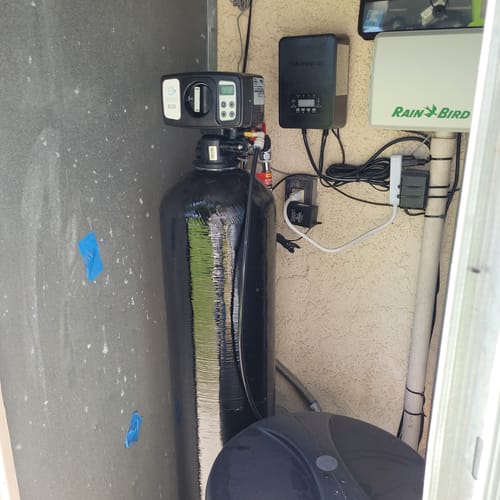
My research journey began with a simple Google search and quickly became a deep dive into water treatment chemistry. I discovered that not all "water softeners" actually soften water in the traditional sense.
Salt-free systems, technically called "water conditioners," use template-assisted crystallization or catalytic media to change the structure of hardness minerals without removing them. While this can reduce scale buildup, it doesn't eliminate the soap scum and cleaning issues I was experiencing. The minerals remain in the water, just in a different form.
Traditional salt-based ion exchange systems physically remove calcium and magnesium minerals by replacing them with sodium ions. This process requires regeneration cycles where the system backwashes and recharges the resin bed with a brine solution. It's more maintenance-intensive but delivers true soft water.
Capacity calculations became crucial. Our household of four uses approximately 240 gallons per day during peak periods. With 18 gpg hardness, I needed a system capable of removing 4,320 grains of hardness daily. Most residential systems range from 24,000 to 64,000 grain capacity, determining how often regeneration cycles occur.
I prioritized several key features:
• High-efficiency resin for better mineral removal
• Demand-initiated regeneration to minimize salt and water waste
• Bypass valve for installation and maintenance flexibility
• NSF certification for performance verification
• Compact design for our limited utility room space
The SoftPro ECO stood out because of its upflow regeneration design and high-capacity resin. Unlike traditional downflow systems that can channel and reduce efficiency over time, upflow regeneration provides more complete resin cleaning and longer media life. The demand-initiated controls meant it would only regenerate when actually needed, not on an arbitrary schedule.
Unboxing and Initial Assessment
The SoftPro ECO arrived in a surprisingly compact package considering its 48,000 grain capacity. The shipping was well-organized with clear labeling – the main unit, brine tank, bypass valve kit, and installation hardware arrived in separate, clearly marked boxes.
First impression: this unit feels substantial without being overwhelming. The control head has a clean, modern design with a digital display that's actually readable without squinting. The resin tank is a single piece construction rather than multiple components, which I appreciated for potential leak prevention.
The included documentation exceeded my expectations. Instead of the typical fold-out poster with tiny text, SoftPro provided a comprehensive installation manual with softprowatersystems.com actual photographs, not just line drawings. The sizing charts helped confirm I'd selected the right capacity for our household.
Quality indicators I noticed:
• Heavy-duty bypass valve with easy-to-operate handles
• Stainless steel control valve components
• High-grade resin visible through the transparent tank section
• Safety float in the brine tank to prevent overflow
• Detailed programming instructions for different water conditions
One minor concern: the unit was larger than I anticipated based on the online specifications. While it fit in our utility room, homeowners with tight spaces should carefully measure. The brine tank, in particular, needs clearance for salt loading from the top.
Installation Experience and Initial Setup

I chose professional installation despite being relatively handy, primarily because I wanted warranty protection and proper initial programming. Our local installer had SoftPro experience, which proved valuable for optimizing the settings for Nevada water conditions.
The installation process took approximately four hours, including:
• Installing the bypass valve on our main water line
• Running drain line to our utility sink
• Connecting power supply (standard 110V outlet)
• Programming the control head for our specific water hardness
• Initial system startup and testing
Our installer tested the incoming water hardness at 17.8 gpg (confirming my test kit results) and programmed the system accordingly. The initial regeneration cycle takes about 90 minutes, during which we had bypass water available – still hard, but functional for basic needs.
Initial startup observations:
• Control panel programming was straightforward with clear prompts
• First regeneration cycle ran automatically after initial setup
• System operates quietly – barely noticeable in our utility room
• Immediate difference in water feel during first soft water test
The installer educated us on the regeneration schedule. Based on our usage patterns and hardness level, the system would typically regenerate every 4-5 days, consuming about 6 pounds of salt and 45 gallons of water per cycle. This seemed reasonable compared to timer-based systems that regenerate on schedule regardless of actual usage.
One installation tip: the drain line placement matters more than I realized. Our installer positioned it to prevent siphoning and ensure proper backwash flow. Improper drain installation can cause regeneration problems and reduce system efficiency.
Performance Analysis: Six Months of Real-World Testing
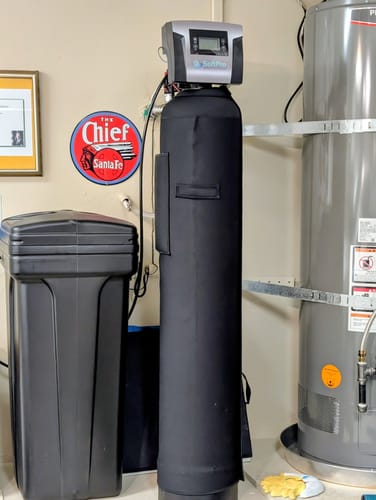
The transformation was immediate and dramatic. Within 24 hours of installation, I noticed the "slippery" feel of truly soft water in our shower – a sensation I'd forgotten from our previous home. My skin felt less tight and itchy after bathing, and my hair was noticeably less brittle and easier to manage.
Quantified Results After 30 Days:
• Incoming water hardness: 17.8 gpg
• Post-softener hardness: 0.5 gpg (essentially zero)
• Regeneration frequency: every 4.2 days average
• Salt consumption: 5.8 pounds per regeneration cycle
• Iron levels reduced from 0.3 ppm to undetectable
The soap scum elimination was remarkable. Our shower doors, which previously required CLR treatments weekly, now stay clear with just regular squeegee use. I reduced our liquid soap usage by approximately 40% because a little goes much further in soft water. Clothes feel softer and colors appear more vibrant without the mineral film.
Appliance performance improvements became apparent within weeks:
• Dishwasher: glassware emerges spot-free without rinse aid
• Coffee maker: noticeable taste improvement, reduced descaling needs
• Water heater: utility bills decreased as heating efficiency improved
• Washing machine: reduced detergent requirements, cleaner results
Six-Month Performance Evaluation:
The system maintains consistent performance with minimal efficiency degradation. Regeneration frequency has stabilized at every 4-5 days depending on seasonal usage variations. Summer months with increased irrigation and pool filling trigger more frequent regeneration, while winter usage allows longer intervals.
I track performance using weekly hardness test strips. Results consistently show 0-1 gpg post-treatment hardness, indicating the ion exchange resin remains highly effective. The demand-initiated regeneration prevents waste while ensuring we never experience hardness breakthrough.
Unexpected benefits discovered:
• Reduced static cling in laundry
• Longer life for soap and shampoo bars
• Easier cleanup after cooking (no mineral spots on cookware)
• Improved lather from hand soaps and body washes
Operating Costs and Long-Term Value Analysis
Ongoing operational costs proved lower than anticipated. Salt consumption averages 45-50 pounds monthly, costing approximately $12-15 when purchasing in bulk. Water usage for regeneration adds roughly $8-10 monthly to our utility bill, but this is offset by improved water heater efficiency.
Monthly Operating Cost Breakdown:
• Salt (solar salt pellets): $14
• Additional water usage: $9
• Electricity (minimal): $2
• Total monthly operating cost: $25
Savings Generated Monthly:
• Reduced cleaning products: $35
• Eliminated bottled drinking water: $25
• Decreased soap/detergent usage: $18
• Estimated appliance protection value: $20
• Total monthly savings: $98
Net monthly benefit: $73 in reduced expenses
The return on investment timeline is approximately 18 months based purely on operating savings. However, the convenience factor and improved quality of life provide value that's difficult to quantify financially.
Long-term cost considerations include resin replacement every 8-12 years (estimated $200-300) and potential control head service after 10-15 years. These maintenance costs are minimal compared to the ongoing savings and appliance protection benefits.
Efficiency comparison to timer-based systems: The demand-initiated regeneration saves an estimated 25-30% on salt and water usage compared to systems that regenerate on fixed schedules regardless of actual consumption.
Maintenance Reality and Long-Term Ownership
Daily maintenance is virtually non-existent. The most frequent task is adding salt to the brine tank every 6-8 weeks, which takes about 10 minutes. I use solar salt pellets rather than rock salt to minimize impurities and extend resin life.
Routine Maintenance Schedule:
• Weekly: Check salt level (visual inspection)
• Monthly: Test output water hardness with strips
• Quarterly: Clean brine tank rim and inspect for salt bridging
• Annually: Sanitize system with resin cleaner
The annual sanitization process involves running iron-out cleaner through the system followed by a manual regeneration cycle. This removes any accumulated iron or organic matter that could reduce resin efficiency. The process takes about 3 hours but most of that is passive waiting time.
Salt bridging – where salt forms a hard crust above water level – occurred once during our first winter. This prevented proper brine formation and temporarily reduced softening effectiveness. Breaking up the bridge with a broom handle and adding hot water resolved the issue. Using higher quality salt pellets has prevented recurrence.
System monitoring is simplified by the digital display showing days until next regeneration, current water usage, and regeneration history. Error codes appear if issues develop, though we haven't experienced any problems in six months of operation.
Durability observations after extended use:
• Control head buttons remain responsive and display stays clear
• Bypass valve operates smoothly without leakage
• Brine tank shows no cracking or structural issues
• Resin bed appears unchanged through transparent tank section
Customer support experience: I contacted SoftPro once with a programming question. Response was prompt and knowledgeable, with technical support walking me through optimization settings for our specific water conditions.

Final Assessment and Buying Recommendation
After six months of ownership, the SoftPro ECO has exceeded my expectations in performance, efficiency, and reliability. The upfront investment has already begun paying dividends through reduced operating costs and dramatically improved water quality throughout our home.
Key Strengths:
• Exceptional hardness removal efficiency (18 gpg to <1 gpg consistently)<p> • Demand-initiated regeneration minimizes waste
• Quiet operation and reliable performance
• Comprehensive installation documentation
• Reasonable operating costs with quantifiable savings
• Compact design for residential installations
Minor Considerations:
• Requires adequate utility space for both softener and brine tank
• Professional installation recommended for warranty and optimal performance
• Salt loading requires lifting 40-pound bags periodically
• Initial investment higher than basic timer-based units
Who should consider the SoftPro ECO?
Homeowners with moderate to severe hardness (above 10 gpg) who want a reliable, efficient solution with minimal ongoing maintenance. Particularly suited for households that value appliance protection and are willing to invest in long-term water quality improvement.
Who might consider alternatives?
Homeowners with mild hardness (under 7 gpg) might find salt-free conditioners adequate. Those with extremely limited space or rental situations might prefer portable or smaller capacity units.
Looking back, I wish we had installed this system when we first moved in three years ago. The cumulative savings on cleaning products, appliance protection, and improved quality of life would have made the investment even more worthwhile. If you're dealing with hard water issues similar to what we experienced, the SoftPro ECO delivers authentic solutions with measurable results.
The transformation from frustrating hard water problems to effortless soft water living has been remarkable. Our Nevada home now provides the water quality we remember from previous locations, and I no longer dread cleaning mineral buildup or worry about premature appliance failure. For our specific situation and water conditions, this system has proven to be an excellent long-term investment.